Monday, May 19, 2014

Book Study--Post #6

This post is part of a series of posts sponsored by SCBWI Florida Tampa Bay area writers. We invite you to join us in this online book study of THE WRITER’S JOURNEY: MYTHIC STRUCTURE FOR WRITERS, Third Edition by Christopher Vogler.

Post #6
Book 2, Pages 117-141
Contributor: Fred Koehler

The Mentor
“Ready are you? What know you of ready? For eight hundred years have I trained Jedi. My own counsel will I keep.” ~Yoda

As our hero continues on his or her quest, it is the writer's job to really put the screws to said protagonist. If it wasn't hard, there wouldn't be a story. And according to Vogler, the character of the Mentor appears to fill a gap in the hero's life, a missing piece without which failure would be certain. Vogler also tells us that the Mentor doesn’t have to be an actual character–our hero can gain wisdom through other sources like an ancient scroll or mountaintop experience. The key is that he or she adopts the humility to seek wisdom.

Mentor Conflicts & Cliches
The hero needs direction and development to succeed, but he or she isn’t always going to accept it easily. There’s great opportunity for conflict as the hero tries and fails, with the mentor standing by shaking his or her head. 

Harry Potter has Dumbledore and Bilbo has Gandalf and Arthur has Merlin. And yet we are warned by Vogler to be careful when considering the archetypal white-bearded wizard mentors. I totally get it. It makes sense to turn the archetype on its head and make the mentor a life-long jailbird or a transient vagrant. But I also see where the archetype has worked stupendously well. 

For extra fun, consider a character who’s parading as a mentor. Or one who dislikes the hero so much he or she changes his or her mind about helping out. Oh, and total spoiler alert–a lot of times the aged hero becomes the next mentor. The student becoming the master and all that jazz.

Crossing the First Threshold
“This is your last chance. After this, there is no turning back. You take the blue pill—he story ends, you wake up in your bed and believe whatever you want to believe. You take the red pill—you stay in Wonderland and I show you how deep the rabbit-hole goes.” ~Morpheus

According to Vogler, there’s a moment in every hero’s story where they’ve committed to the adventure with no option to turn back. It makes them stuck in the story and gives the reader incentive to cheer them on, hope for their success, and hang on the edge of their seats at every seemingly unsurmountable challenge.

Pushing the Hero across the Threshold
Oh, man. There are a million twisted ways to make that poor hero get stuck in his/her adventure. Vogler mentions a lot of examples of death. I’d add to the list personal tragedy, opportunities too good to pass up, love, and zombie apocalypses. 

But wait. We can’t make it too easy for our hero to dive off the ship and watch it sail away. Vogler invokes an archetype called the Threshold Guardian, who tends to show up anytime the hero is about to jump. It could be the best friend urging him/her to stay on the ship. Or maybe it’s the just the troll demanding that his toll be paid before the hero can cross the bridge. 

The good news is that once we cross that threshold, it’s all smooth sailing and success is very nearly achieved. Oh, wait, never mind. That’s not what Vogler said at all. We just had our hero leap from the burning wreckage of the Titanic into the icy waters of the Atlantic. Now the real struggle for survival begins. 

Tests, Allies, Enemies
“Halt! Who goes there?! Friend or foe?!” 
“Carrot!”
~Monty Python

Did you get it? If you don’t answer friend or foe it becomes a test of wisdom and discernment. Not too shabby, Mr. Python. Vogler identifies an entire stage of the journey called Testing, where our heroes are put into worlds that sharply contrast the ones they’re accustomed to. In this new world, they’ve got to hone their wits and abilities to adapt in order to survive. 

And in this new struggle to survive, says Vogler, our hero is going to encounter not only unfamiliar characters, but unfamiliar types of characters. Harry Potter had never spent time with a half-giant magical gamekeeper before he met Hagrid. Nor had he met the son of a rich, ruthless servant of Voldemort (the ultimate evil).

And yet our hero must decide who they’re going to trust, which alliances they’re going to accept or reject, and how much they’re willing to risk to secure the ones they’ve chosen. Get one ally and you either get a sidekick or become one; get a bunch of allies with a common goal and you’ve got a Team. Go Team!

Both allies and enemies can help the hero learn the rules of this new world. And the tougher we make it for the hero to thrive, the more our readers will be biting their nails to see whether or not our characters survive.

Meet Today’s Contributor—Fred Koehler
Fred Koehler wrote and illustrated his first book at age seven titled SAMMY THE SHOESTRING. It went on to win a shiny gold star sticker and an iced cinnamon bun from the vending machine in the teachers’ lounge. From that point on, Fred has never stopped doodling or writing stories (except when he tried to be a grown-up for a few years, which didn’t really work out). Fred is the author and illustrator of HOW TO CHEER UP DAD, a critically acclaimed debut from Penguin USA. He lives, works, and plays in Lakeland, Florida.

Thursday, May 15, 2014

Book Study--Post #5


This post is part of a series of posts sponsored by SCBWI Florida Tampa Bay area writers. We invite you to join us in this online book study of THE WRITER’S JOURNEY: MYTHIC STRUCTURE FOR WRITERS, Third Edition by Christopher Vogler.

Post #5
Book 2, pages 81-114
Contributor: Sue LaNeve 

Rob Sanders inspired the writers of Tampa Bay with this Call to Adventure, inspiring me to follow Christopher Vogler into Book Two, Stages of the (Writer’s) Journey.

Before beginning a tale, we storytellers have significant choices that set the mood by which our readers will experience our work. Vogler cites director Max Reinhardt’s creation of atmosphere before the curtain goes up with the title, promotion, music, lighting, and costumed ushers, all affecting the audience’s experience and expectations. Similarly in publishing, our title, opening image, whether or not we use a prologue all possess metaphorical power to set the stage.
-        Vogler illustrates how a title and its graphical representation –in this case, the words God and Father and a puppeteer’s strings which describe Don Corleone’s power in the Godfather—can be a multi-leveled metaphor.
-        In the film Unforgiven, the opening scene alludes to backstory and what is to follow when Clint Eastwood is seen digging his wife’s grave.
-        Regarding a prologue Vogler states that “the needs of the story will always dictate the best approach.” Prologue may provide backstory, set mood, and hint of extraordinary events to follow. Some prologues seek to disorient the reader, helping them to accept incredible events to follow. Once we make these opening choices, we begin our tale by establishing the multi-functional

ORDINARY WORLD
How do we differentiate between dark and light if we have one without the other?  Vogler says we must know our hero’s ORDINARY WORLD to appreciate her journey into SPECIAL WORLDS, and that we make it much different from the special world “so audience and hero will experience a dramatic change when the threshold is finally crossed.”

Though seemingly boring, the ORDINARY WORLD has significant functions. It is the stage for:
-        the conflicts and problems the hero will face in the special world
-        foreshadowing characters or events to follow.
-        the story’s action and dramatic questions whose answers will ultimately solve the hero’s inner and outer problems. Both must exist for the characters to seem fully fleshed out.
-        the hero’s entrance—her clothes, actions, mood, goals will affect her relationship with the reader. Her actions should echo character and her normal attitude, setting the stage for future problems and/or solutions—unless, of course, you are purposefully trying to disguise her true nature from the reader.
-        a place to express the story’s theme—what you are trying to say, the “underlying statement or assumption about an aspect of life.” Vogler believes it should be stated in Act One in some way and set the stage for everything else to echo it.

Vogler advises us to create a hero who is not necessarily likeable, but relatable so the reader will project “a part of their ego in the character.” Give them universally experienced goals, drives, desires or needs.

Our hero may lack something—compassion, or perhaps a mate or parent. Like Aristotle’s Greek theory of tragedy, every fleshed-out hero has some tragic flaw that shows his humanity. It could be a wound, either physical or emotional to make them sympathetic and interesting. We writers may keep this wound secret from our audience, while still creating a character with a personal history and sense of realism. Says Vogler, “We all bear some scars from past humiliations, rejections, disappointments, abandonments, and failures.”

We must know early on what’s at stake if the hero succeeds or loses and we must make it significant enough to make the reader care.

Finally, regarding backstory and exposition, Vogler discusses how difficult it is to do this elegantly and prefers to let the reader work to figure it out through the course of the story.

THE CALL TO ADVENTURE
Within the ORDINARY WORLD, the “seeds of change” are waiting for a something “to germinate” them—what Joseph Campbell termed THE CALL TO ADVENTURE (aka the trigger, catalyst, inciting or initiating event.)

It may be:
-        a declaration of some sort
-        a stirring within the hero
-        a temptation to travel or be seduced
-        unconscious metaphorical imagery and dreams
-        synchronous ideas or events that take on meaning
-        the last straw that kicks the hero into motion

The “CALL” may:
-        come from a HERALD and/or MENTOR archetype
-        present the hero with an invitation or challenge
-        kick away the crutches that keep the Hero from taking risks
-        create disorientation and discomfort necessary for growth
-        be a villain surveying a hero’s territory—alerting the audience, more than the hero, that something is about to change
-        be from a lack or need presented to the hero
-        result from the hero having no other choices but to change or create change.

Some stories may have more than one CALL

REFUSAL OF THE CALL
The hero has received the CALL, but what will she do? This stop in the action:
-        conveys that inherent danger awaits our hero
-        may express our hero's reluctance from having learned her lessons
 
Volger says audiences enjoy seeing the reluctance overcome.

Even a hero who is a willing Seeker faces refusal to the CALL, often by others who warn of what’s ahead—THRESHHOLD GUARDIANS—who:
-        block the hero from beginning her journey
-        test the hero’s commitment
-        create drama for the audience by asking if our hero is capable of facing what’s ahead
-        may have previously been the hero’s MENTOR
 
We writers face conflicting CALLS:
1.    to experience life fully to find material for our work, and
2.    to cut ourselves off to create it.

We also must contend with the pull of our own ORDINARY WORLDS that try to distract us and/or keep us safe from taking risks, leading us to refuse the CALL.

In my current work in progress, I feel the CALL TO ADVENTURE from synchronous sources, while daily facing my own tendency to REFUSE THE CALL.

Meet Today’s Contributor—Sue LaNeve
Sue LaNeve is both an author and a ship's Captain who lives aboard a Kadey Krogen trawler, Freebird, currently docked in St. Petersburg, FL. She is a graduate of The Vermont College of Fine Arts where she earned an MFA in Writing for Children and Young Adults and a membership in S3Q2, the Super Secret Society of Quirk and Quill. An extended sea journey encouraged her decision to self-publish her debut novel, SPANKY: A SOLDIER’S SON, which has earned decent reviews and a Bronze Medal from the Military Writers Society of America. You can and learn more about her at www.MyClimbingTree.com and read her blog posts at www.QuirkandQuill.com.
 

Monday, May 12, 2014

Book Study--Post #4

This post is part of a series sponsored by SCBWI Florida Tampa Bay area writers. We invite you to join us in this online book study of THE WRITER’S JOURNEY: MYTHIC STRUCTURE FOR WRITERS, Third Edition by Christopher Vogler.

Post #4
Book 1 pages 65-80
Contributor: Cassie Trohn

I was very intrigued by Christopher Vogler’s description of what certain characters’ roles are, as well as the meaning behind what these characters do.
          Today I will introduce you to three character types that I read about— Shadow, Ally, and Trickster.

SHADOW:
          Vogler describes Shadow as the energy of the dark side, the unexpressed, unrealized, or rejected aspects of something. This is the negative face of Shadow in a story and is represented by characters that are villains, antagonists, or enemies. The Shadow can be the suppressed things about our characters, dark secrets, and things that lurk in their past. Villains are usually dedicated to death, destruction, or defeat of the hero.
          The positive face of the Shadow shows this archetype in a more genuine light. Qualities that hide or that have been rejected for some reason can bring out the positive side of the Shadow. The positive side can make the Shadow more human with a touch of goodness or some quality that is admirable or even vulnerable. The positive face can almost give the reader a sense of feeling sorry for the villain because he/she has shown a more human side, or a reason why he/she reacts the way he/she does.
          The function of the Shadow is to challenge the hero and give him/her a worthy opponent in his/her struggle. Shadows can create conflict and bring out the best in a hero, often by putting the hero in a life-threatening situation. Heroes can also manifest a Shadow side, by wearing a mask.
          The mask of the Shadow can be worn by any character, for instance: the primary Mentor figure who tests the MC by pushing him to his limit (Louis Gossett, Jr., An Officer and a Gentleman), the Shapeshifter figures, darker characters that act like Mentors (Anthony Hopkins, The Silence of the Lambs), the Trickster figures, villains who fight bravely for their cause or experience a change of heart only to become heroes themselves (the Beast—Beauty and the Beast)
          External Shadows must be vanquished or destroyed by the Hero. Internal Shadows can be disempowered by bringing them into the light of consciousness and can even be turned into a positive force.
          Knowing the psychological concept of the Shadow archetype will help you understand the villains and antagonists in your stories and uncover deeply hidden aspects of your heroes.

ALLY
          The Ally character can serve several purposes for the hero. The Ally can be a companion, conscience, comic relief, or someone to run errands, carry messages, scout locations or have someone for the hero to talk to. The Ally brings out the human side of the hero or challenges him/her and allows for a more balanced hero. You can have multiple Allies building up a team of adventurers with each having their own special skill, or just a single Ally who provides comic relief and/or challenges a deeper look into the hero’s soul.
          Allies can explain things that are second nature to the hero who is introverted or that would be awkward for him to explain.
          The Ally can also be an “audience character” who is someone who sees the world in a special way or through fresh eyes. This is my favorite type of Ally. I have a tendency to want to have another character other than the Main Character throw a fresh light on circumstances.
          Allies can be sidekicks. They can be a comical sidekick, a faithful sidekick, an accomplice, or serve as a conscience. An Ally could be the most effective in drawing more emotion into your story.
          The Ally can also be non-human, such as a guardian angel, or a spirit protector. Animal Allies are common in storytelling and make great allies. In folktales, Allies can serve as a voice beyond the grave giving aid to the living. Helpful servant Allies can help the hero achieve his/her goal.
          The psychological function of an Ally is to be helpful to the hero in the journey of the hero’s life. The Ally represents powerful internal forces that can come to the aid of a MC in a spiritual crisis.

TRICKSTER
          The Trickster archetype is very popular in folklore and fairytales. They are usually clowns or comical sidekicks. They embody the energy of mischief and desire for change. They have several important psychological functions. They are good at cutting big egos down to size and bringing heroes and audiences down to earth. They bring about healthy change and transformation, often by pointing out the imbalance or absurdity of a stagnant psychological situation. Tricksters are known to bring needed perspective when characters might be taking themselves too seriously.
          The dramatic function of comic relief is to relieve tension, suspense, and conflict. Tricksters can be servants or Allies working for the hero or Shadow. They can also be independent agents with their own agendas.
          Trickster Heroes are most common in folktales and fairytales and can stir up trouble or outwit others, bringing about change. They are usually catalyst characters who affect the lives of others but are unchanged themselves.

Meet Today’s Contributor—Cassie Trohn
My name is Cassie Trohn and as a Reading Specialist for children with disabilities such as ADD and Dyslexia, I found my love in writing. I did not start out in Education; I actually was a wedding planner for eleven years. I have four children. I am also an artist and combine the arts with reading in order to help with sensory learning. It really speeds up the process of teaching reading if you know what type of learner your student is (visual, audio, hands-on).
My writing background is very formal. What I mean is I have written articles for local magazines and was a ghost writer for an international business company. Although my writing background has been a formal writing style, my love for writing was much more creative and I’ve wanted to entice teens to read more, especially those with disabilities. I want to be the author who keeps them reading through their adult years. I am presently working on a YA fiction trilogy, “Three Rings” with my mentor and editor, Joyce Sweeney.

Thursday, May 8, 2014

Book Study--Post #3


This post is part of a series sponsored by SCBWI Florida Tampa Bay area writers. We invite you to join us in this online book study of THE WRITER’S JOURNEY: MYTHIC STRUCTURE FOR WRITERS, Third Edition by Christopher Vogler.

Post #3
Book 1, Pages 39-63
Contributor: Nancy Stewart
Who among us has not had a mentor or two along life’s path?  In his book, The Writer’s Journey, Christopher Vogler speaks in great depth about the value of The Mentor: Wise Old Man or Woman. The genesis of the word mentor comes from The Odyssey and is a character who guides the young man, Telemachus on his Hero’s Journey.
Much is made of the role of mentors’ roles in Book 1, including the Psychological Function of this archetype. Vogler makes the argument that many heroes seek out mentors because their parents are or were inadequate role models. As an example, he suggests that Merlin is a surrogate for the young King Arthur whose father is dead.
There are types of mentors whose functions are as varied as characters to be assisted by them, whether willing or unwilling. As with heroes, dark or negative sides can be expressed, such as a mentor’s trying to influence the character by putting obstacles in his or her path.
Mentors are there to provide their heroes guidance, motivation, inspiration, training, and gifts for their journey. Whether the mentor is an actual character or an internal code of behavior, the mentor archetype is a powerful and necessary tool for the writer.
Threshold Guardian
       One doesn’t have a book worth reading if the hero’s path to enlightenment is not strewn with obstacles. A Threshold Guardian should be at the entrance to each new world to keep the unworthy from entering. We learn they may be border patrols, sentinels, night watchmen, bouncers, or doormen, to give the flavor of naming a few. To mix it up a bit, the guardian can also be an animal, force of nature, or architectural feature. The Threshold Guardian’s primary task is to test the hero, so whenever he/she meets one along the way, a test must be given and passed.  In fact, learning how to deal with one’s own Threshold Guardian/s is perhaps the hero’s major task along the journey.
Herald
Many times when a new force appears in Act I to bring on a challenge to the hero, a Herald will deliver it. Herald characters issue challenges and announce the coming of significant changes. Typically, in the opening part of a story, the hero has gotten by somehow. They have handled difficulties by “muddling through” a series of coping mechanisms or defenses, always keeping a status quo about their problems or issues. Suddenly a new condition, or person, or circumstance comes along and changes the hero forever.
Often the Herald, in a straightforward manner, does exactly what s/he is supposed to do: Bring news to the hero that a new energy will soon change the balance. This archetype, however, can be a positive, negative, or neutral figure. An example is found in the film, Romancing the Stone when the Herald for Joan Wilder is a treasure map arriving in the mail and a phone call from her sister who is being held hostage in Columbia. As the Herald’s driving force is delivering news of change, this figure is necessary to almost every story.
Shapeshifter
The word elusive was made for the Shapeshifter archetype. By definition then, its very nature is to be unstable and ever-changing, and not surprisingly, serves the dramatic function of bringing doubt and suspense to a story. It’s no wonder this archetype is often found in noir films such as: The Big Sleep, The Maltese Falcon, and Chinatown. In Fatal Attraction, the hero is confronted by a Shapeshifting woman who morphs from a passionate lover into an insanely murderous mistress. The Shapeshifter is a powerful as well as flexible archetype who many times is a member of the opposite sex.
To recap: Mentors, Threshold Guardians, Heralds, and Shapeshifters are quintessential archetypes reflecting the human condition for as long as humans have been “modern,” from an archaeological standpoint. As such, they make powerful “everyman” characters that are pivotal to telling a story wisely and well. 

Meet Today’s Contributor—Nancy Stewart
Nancy Stewart is the author of the Bella and Britt picture book series. Her book, Katrina and Winter: . Partners in Courage, is the authorized biography of Katrina Simpkins and her life changing relationship with Winter, the dolphin. All are published by Guardian Angel Publishing. Nancy’s book, One Pelican at a Time and she were featured in the PBS Tampa special, GulfWatch. A frequent speaker and presenter at writing conferences throughout the United States, Nancy is also a judge in the Rate Your Story organization.  A blogger with an active worldwide audience, she writes of all things pertaining to literature for children. Nancy is fortunate to have been around the world and back again and is the U.S. chairwoman of a charity in Lamu, Kenya that assists girls in furthering their education through high school.


Monday, May 5, 2014

Book Study--Post #2


This post is part of a series of posts sponsored by SCBWI Florida Tampa Bay area writers. We invite you to join us in this online book study of THE WRITER’S JOURNEY: MYTHIC STRUCTURE FOR WRITERS, Third Edition by Christopher Vogler.

Post #2
Book 1, pages 1-36
Contributor: Shannon Hitchcock 

Christopher Vogler says, “The hero’s story is always a journey.” He defines a hero as the character who usually:
1.    Learns or grows the most.
2.    Has the most action.
3.    Is connected with self-sacrifice.
Sacrifice is the true mark of a hero. As readers we identify with him and see the world through his eyes.
 
There are several types of heroes:
1.    Willing & Unwilling.
2.    Anti-heroes, (e.g. Robin Hood, villain in the eyes of society, but the reader sympathizes with him).
3.    Group Oriented Heroes.
4.    Loner heroes – think Clint Eastwood.
5.    Catalyst Heroes, (e.g. Eddie Murphy’s character Axel Foley in Beverly Hills Cop. Axel doesn’t change very much during the movie, but the other characters change because of him)
Once we meet and identify with the hero, we’re ready to go on a journey with him. It can be an outward journey to an actual place, or an inward journey of the mind, the heart, and the spirit.

Christopher Vogler uses a twelve-stage heroes journey. It goes like this:
1.    Most stories start in the ordinary world; Dorothy’s story started in Kansas.
2.    In the ordinary world, our hero receives a call to adventure.
3.    The hero is often reluctant and refuses the call,
4.    But is encouraged by a mentor to accept the challenge.
5.    The hero enters the special world where he encounters tests, allies, and enemies.
6.    In the special world, the hero approaches the inmost cave, (the most dangerous place, like Indiana Jones entering The Temple of Doom).
7.    He endures the ordeal,
8.    Takes possession of the reward,
9.    And is pursued back to the ordinary world, (often there’s a great chase scene).
10.Death and darkness make one last attempt to defeat our hero.
11.He overcomes the final challenge and is transformed.
12.In the end, the hero returns from his quest to benefit the ordinary world. 

As I was reading and studying these stages, I tried to make my novel, THE BALLAD OF JESSIE PEARL fit neatly into the twelve steps. JESSIE is not a precise fit. That made me skeptical until I came across this passage, “The stages can be deleted, added to, and drastically shuffled without losing any of their power.” In other words, the structure is a tool, a way to think through plot, but it doesn’t necessarily have to be followed to the letter. When I consider the stages in those terms, I can see how they might help me.

How about the story you’re currently crafting? Does it fit neatly into the twelve stages of the hero’s journey? If not, what stages have you added, left out, or shuffled? Leave a comment and let’s discuss.

Meet Today’s Contributor—Shannon Hitchcock
Shannon Hitchcock is a Tampa based freelance writer. Her debut novel, THE BALLAD OF JESSIE PEARL was published by namelos in 2013, and her latest novel, CAROLINA GIRLS is under contract with Scholastic. You can learn more about Shannon at http://www.shannonhitchcock.com.

Thursday, May 1, 2014

Book Study--Post #1


This post is part of a series of posts sponsored by SCBWI Florida Tampa Bay area writers. We invite you to join us in this online book study of THE WRITER’S JOURNEY: MYTHIC STRUCTURE FOR WRITERS, Third Edition by Christopher Vogler.

POST #1
Introducing the Writer’s Journey
Pages xi-xxxiii
Contributor: Susan Banghart

In his introduction to the third edition of The Writer’s Journey, Mythic Structure for Writers, Christopher Vogler says, “All stories consist of a few common structural elements found universally in myths, fairy tales, dreams and movies. They are known collectively as The Hero’s Journey. Understanding these elements and their use in modern writing is the object of our quest.”

For Vogler, the quest started with his love of the Little Golden Book fairy tales his grandmother and mother read to him. This led to an impressive career in the movie industry. Along the way he encountered Joseph Campbell’s The Hero with a Thousand Faces and used Campbell’s concept of The Hero’s Journey to analyze blockbuster films. Not long after he presented his findings, Hollywood adopted The Hero’s Journey as a storytelling guide.

Vogler believes people are drawn to stories that replay the hero’s mythic journey. He also sees it as a guide to life. It is, he says, “a complete instruction manual in the art of being human. A set of principles that govern the conduct of life and the world of storytelling the way physics and chemistry govern the physical world.”

The Hero’s Journey theory has been tested on films, from animation to big budget movies. Vogler has traveled the world teaching story construction, facing challenges from herophobic cultures and critics who condemned The Hero’s Journey as formulaic and dominated by male warriors. He argues the list of possible heroes is endless: male or female, pacifist, mother, fool, lunatic, coward. He says The Hero’s Journey should be used as a form, not a formula. It is meant to be absorbed and recreated, not copied.

Vogler sees his concept as an ever evolving tool. In the appendix, he introduces some of what he’s learned in the years since publishing the third edition of The Writer’s Journey, including segments on polarity, catharsis and body wisdom. I was intrigued by his idea that good stories affect more than one organ. He says if there’s no physical reaction to the readers’ body, the story is only connecting with the intellect. I don’t know about you, but that makes me want to skip to the appendix and read more! First things first.


          In Book One of The Writer’s Journey, we explore The Map of the journey through the world of story and meet eight of the many archetypes: Hero, Mentor, Threshold Guardian, Herald, Shapeshifter, Shadow, Ally and Trickster. Book Two introduces the twelve stages of The Hero’s Journey, from Ordinary World to the hero’s Return with the Elixir. In the epilogue, Vogler analyzes films and offers advice against story writing pitfalls. Adorning this post and heading each chapter are beautiful tarot-like illustrations by Michele Montez, an artist Vogler met while creating manga.

I chose to do a broad overview of the introductions and preface in case, like me, your eyes glaze when you see too much text on blog posts. But I encourage reading the material, especially the preface where Vogler speaks of his critics, cultural differences he’s experienced and America’s possibly negative influence on worldwide storytelling.

To end, I’ll leave you with a taste of Vogler’s style. Comparing editing to building boats, he says, “The spine of the story is like the keel, the major plot points are the ribs, and the individual scenes and lines of dialog are the planks and rigging that complete the vessel, a vehicle that you hope will sail the seas of public attention.”

Meet Today’s Contributor—Susan Banghart
Susan Banghart is an artist and writer of YA novels, a 2010 winner of the Highlights fiction contest and was awarded Honorable Mention for best YA writing at Eckerd College’s 2013 Writers in Paradise Conference. But what she’s most proud of is being a former member of Rob Sanders’ Picture Books and Java and a current member of Teddie Aggeles’ Skyway Writers, two of the best critique groups on the planet. Susan has a website and blogs at susanbanghart.com.


Wednesday, April 30, 2014

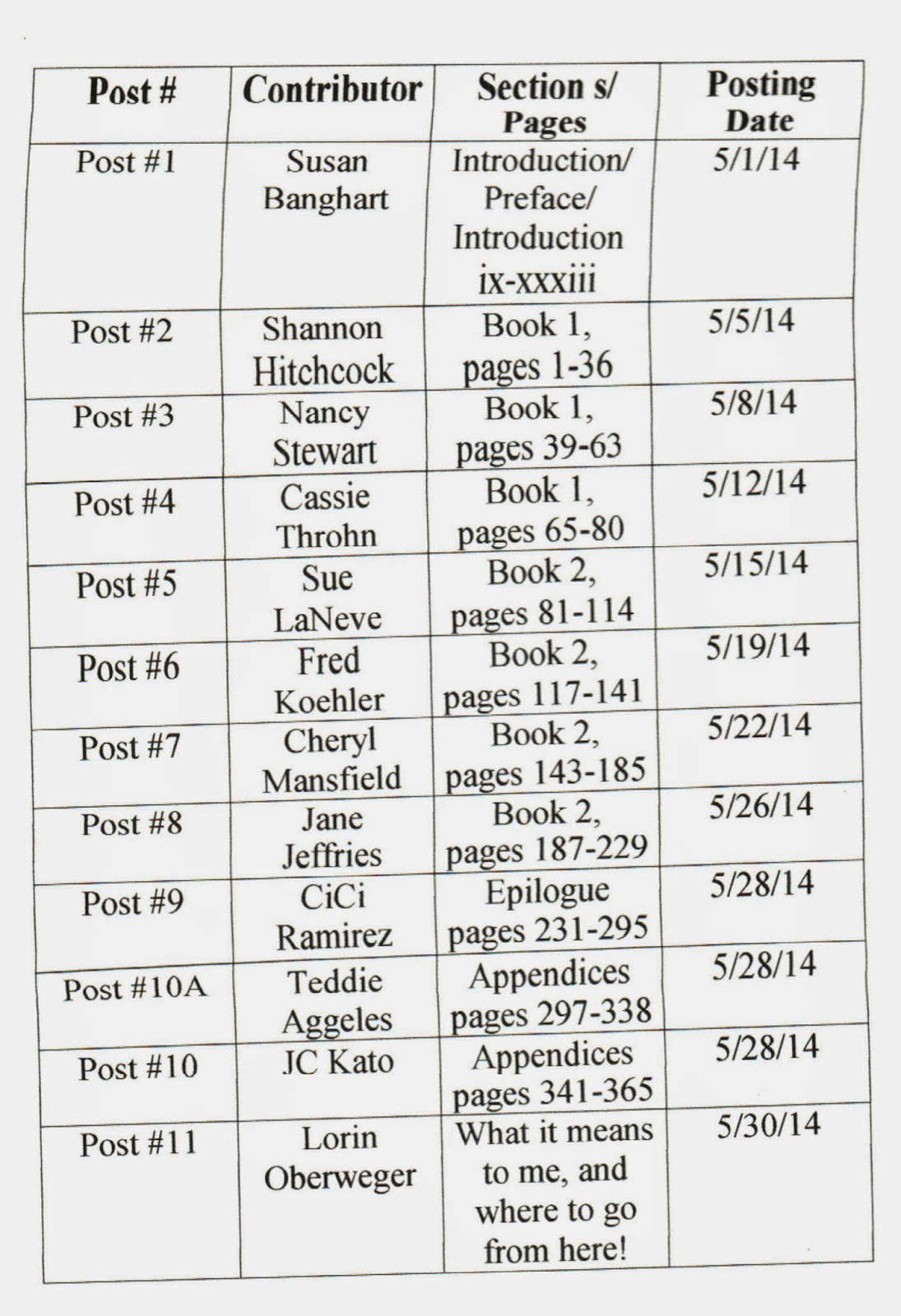
Book Study Schedule


Book Study Begins on Thursday!


You are invited . . . 

SCBWI Florida Tampa Bay Area Writers
invite you to join our
May on-line book study of
THE WRITER’S JOURNEY:
MYTHIC STRUCTURE FOR WRITERS
Third Edition
by Christopher Vogler

Throughout the month of May I will be posting summaries of sections of Vogler’s book. Each post will be a contribution of a different Tampa Bay area writer. We encourage you to buy or check-out a copy of the book, follow along throughout the month, and post your own comments, thoughts, and reflections.


First post: Thursday, May 1!