Monday, November 21, 2011

Yo, Turkey--Playing with Words

Week of November 20: Grateful for a Few More Writing Ideas
Monday, November 21: Yo, Turkey—Playing with Words

Playing with words can often plant the seed for an idea (or help an existing idea begin to germinate). Nothing tricky here—just take a word or phrase or concept that has popped into your head and play with it as much as you can. Don’t start out with any expectations, just let the word spirits lead you!

Let’s take a perfect word for this week—turkey! Now let’s play with it.


IDIOMS
Think of all the turkey idioms you can (and Google turkey idioms to see what you can find). List everything you think of and/or find . . . don’t judge the idiom, accept it. You can decide later if you want to use it or not. Here are my turkey idioms:

·        Going cold turkey
·        Talk turkey
·        Turkey nests (like dust bunnies—“There were turkey nests in every corner.”)
·        A turkey shoot
·        The turkeys are voting for an early Christmas

You can also mash together your word or phrase with other familiar idioms. Such as:
·        Let them eat turkey
·        A turkey on the plate is worth two in the freezer
·        A turkey in every pot
·        Turkey is as turkey does
·        A turkey a day keeps the doctor away

Finding idioms may be enough to move your idea to the next step, but why stop playing now?

RHYMING WORDS
Search for words that rhyme with your focus word(s). Again, list everything you find or think of—don’t limit yourself. For instance:

·        Durkee (as in Green Bean Caserole!)
·        Jerky
·        Murky
·        Perky
·        Quirky

Then you can also make up your own rhyme words to fit the situation or need.

·        Berserky
·        Clean and jerky
·        Desk clerky
·        Irky
·        Jerky
·        Lurky
·        Out of worky
·        Smirky

But don’t stop there! Continue to play with words thinking of literary devices such as similes, metaphors, and onomatopoeias. For instance:

SIMILES      
·        He waddles like a turkey.
·        She felt like a turkey on her way to Thanksgiving dinner.
·        He ignored her like three-day-old turkey leftovers.

METAPHOR
·        You’re a turkey.
·        She was the cranberry sauce to my roasted turkey.
·        He was stuffed like a turkey.

ONOMATOPOEIAS
·        Gobble-gobble-gobble.
·        SQAWK!
·        Flap. Flutter. Flap.
·        Scratch-peck. Scratch-peck. Scratch.
·        Gulp!
·        CHOP!
·        Kerplunk!

Ok, turkey . . . I mean, friend, now that you’ve played with the word(s)/phrase you thought of, you’re ready to take your idea to the next level. Use your new discoveries to create a title, write an initial description, or outline your plot. Then save your word play to inspire and impact the manuscript that grows from your idea.

Sunday, November 20, 2011

Coming This Week!

Week of November 20: Grateful for a Few More Writing Ideas
Quote of the Week:
Everyone is a genius at least once a year. The real geniuses simply have their bright ideas closer together.
—Georg Christoph Lichtenberg

In honor of PiBoIdMo, this week we’ll continue uncovering methods to help discover writing ideas. During this week of Thanksgiving, we’ll uncover a cornucopia of idea-gathering methods. (Ok, to be honest, it will be a small cornucopia with three or four methods!) To get you into the turkey-day mood, all my examples will come from the iconic symbols of the holiday. So put on your pilgrim hat, grab a turkey leg, and get ready to discover a few more idea-discovering methods.

Monday: Yo, Turkey—Playing with Words
Tuesday: Pilgrims, Land Ho—Using a KWL Chart
Wednesday: Two in Tow—Using a Venn Diagram
Thursday: CELEBRATE THANKSGIVING!
Friday: Leftovers, Of Course

Friday, November 18, 2011

Snooping Through Life

Week of November 13—Gathering Ideas
Friday, November 18—Snooping Through Life

I eavesdrop. Yes, I listen in on the conversations of others. My hearing is intensified when something is not my business. It may be a medical condition for all I know. I am not a nosey person (really), I’m just an eavesdropper.

I can repeat entire conversations and even reproduce the voices of the speakers. Of course, if a conversation is not interesting, you’re safe. I’d tune you out in a heartbeat. But let there be one word, one phrase, one sentence that interests me, and I’m hooked.

There was the time I was in the grocery store and heard a woman tell her husband (with great disgust), “Sometimes you are such a man!” Or the fourth grader I overheard on the bus ramp telling other kids, “People with blue eyes are devils.” Or the man being interviewed by a TV news reporter who said, “That tornado did not sound anything like a train. There was no clickety-clack, clickety-clack, woo-woo at all.”

I love being in a crowded airport and floating from conversation to conversation, each telling a different story, and all being told simultaneously. The experience is like visiting the TV department at an electronics store with all the TVs turned on to different stations. Sensory overload of the best kind!

I think (or hope) many of these bits of conversation can be used in my writing. For instance, when I overheard a fourth grader say: “Tomorrow is my birthday. I’m a rain baby, you know. So is my grandfather. We were both born on rainy mornings.” I immediately started planning a story based on the idea. Or when I heard Granny Raney tell my mom, “Your Uncle Clifty never had a name ‘til he went to school. We always called him Brother ‘til then. Still do.” I’ve worked on the draft of that story for years.

Ralph Fletcher writes:

     “Writers are fascinated by talk, obsessed with what people say and how they say it, how they interrupt themselves, the words they repeat, the way they pronounce or mispronounce words . . .
     Keep your ears alert to the conversations of strangers wherever you are and pay attention to what strikes you. You don’t need to write down the whole conversation, often you end up just writing a sentence or phrase in your notebook.”

From: A Writer’s Notebook: Unlocking the Writer within You by Ralph Fletcher, pp. 59-62

Ok, I’m off the hook, because Ralph says writers are supposed to listen to other people’s conversations. But there's another problem. I am also a people watcher. Observing the gate and meter of a person’s walk, a facial expression, or an unintentional fashion statement can tell me loads about a person. (Or, at least I can infer loads about them.)

When I had booths in an antique mall in Nashville we often had country music singers come in to shop. I loved following them (from a respectable distance) as they went from booth to booth. I watched the way these “famous” people picked up items and looked at them, their facial expressions, their walks, their mannerisms. Then I would rush back to the counter and act it out for Carolyn and Margaret who worked up front.

I’m hoping all my “inquisitiveness” will help out when I am developing characters, writing dialogue, or showing my voice through my writing. In the meantime, I’ll just keep on listening and keeping an eye peeled for anything interesting.

It’s Your Turn!
1. You have my permission—start eavesdropping and people watching.
2. Keep notes of what you hear and see. Then see what you can weave into your writing.

Thursday, November 17, 2011

A Picture's Worth a Thousand Words

Week of November 13—Gathering Ideas
Thursday, November 17—A Picture’s Worth a Thousand Words

In his book A Writer’s Notebook: Unlocking the Writer within You, Ralph Fletcher talks about mind pictures. He writes:

“Pay attention to your world. Wherever you are, at all hours of the day, try to drink in the world through your five senses, all of which are incredibly important tools for writers.

Step one: Pay attention. Be ready. Keep your senses peeled.
Step two: Write down what you notice before you forget.
Step three: Later, go back and reread your entry. See if you might want to write more about it.”

From: A Writer’s Notebook: Unlocking the Writer within You by Ralph Fletcher, p. 45

I am always telling stories. Things I've heard on the news, funny things I’ve observed, things that happened at school. But I seldom write those things down. I’m risking loosing those ideas/stories. And I realized today without writing those stories down, I can't find the connections between the stories that might link them into something bigger.

I used to write down things more than I do now. For many years I had booths in antique malls and would sell odds and ends. When I first started, I wrote a brief story to go with each item. My thought was that if I could keep people in the booth reading they might be more likely to buy. I think the owner and other dealers were more interested in my stories than the customers, but it still was a fun endeavor and it was a way to record some of my stories.


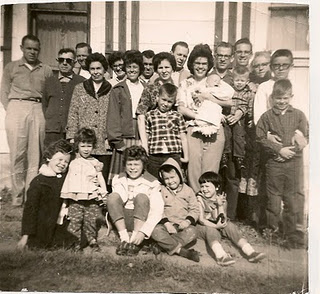
This is the Sanders family, circa 1964. That’s me on the front row, second from the right. I remember posing for the photo. As I look at it today, I get ideas for stories.

That’s my cousin Linda to my left. (The one waving.) We called ourselves twin cousins since we were born two months apart. Twin cousins—interesting story idea.

I think that must be my cousin Dean in the plaid shirt. I see a character in that boy.

My brother Butch and Uncle Jackie (both now deceased) are on the far right of the photo. They grew up only a couple of years apart. My mom always said she raised them both. That’s a story.
Grandpa Sanders (with the dark glasses) was a nearly-blind sharecropper/ shoe cobbler with six children. A War World I veteran, Grandpa was a proud and gentle man. Grandpa Sanders is a story waiting to be written.
·   
My mom stands in front of Grandpa. She’s wearing a coat with a dark faux fur collar. Dad stands behind Grandpa and is dressed stylishly in a tab-collared shirt. I just noticed that he is the tallest man in the group. I have no memory of my parents looking like this. Maybe there’s a story in the reality and perception of our parents.

Almost hidden behind Grandpa is my Uncle Bud (aka Dr. Robert Richert). Uncle Bud and Aunt Betty (my dad’s only sister) were the only college-educated adults in this photo. Maybe there’s inspiration in that fact.

I’ll stop boring you. You get the idea. There are story ideas hidden in our photos. But we can also look for those ideas in the photos of strangers. Almost every thrift store, estate sale, or antique mall has boxes and bins of photos for sale. I have a friend who buys great vintage photos and calls the people in the photos his instamatic family. We can mine these photos for story ideas, too.


I found about twenty snapshots of this woman with her dog (and more of the dog's antics). I bought them. I don’t know why, but there’s a story there somewhere.


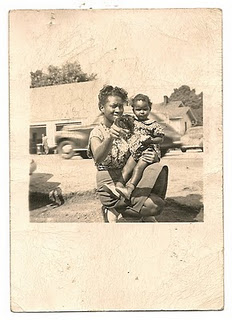
This photo is labled: Effie and her daughter, Evelyn. When I look at this photo, I wonder:
·        Who are these people?
·        Who is taking the photo?
·        Who or what is Effie pointing at?
·        Where has the car in the background taken them or where is it going to take them?
·        Why have they paused to take this photo?
·        What are they thinking? Feeling? Wondering?
·        What happened just before this photo?
·        What happened after this photo was taken?
·        What is Evelyn holding in her hand? She appears to be eating, but what?

This is why I can’t go into antique malls and flea markets very often. I can linger over the photos forever. I also like to search for vintage postcards. Not the destination kind, but the graphic kind. I’ll show you two of my postcards. See what questions they generate in your mind, what story titles pop up, and what plot lines they inspire.


If you’re searching for a story idea, look no further than the mental pictures you take each day, the photos on your walls, and your scrapbooks. But don’t stop there. Search for stories in the photos of others and maybe even the graphics of days gone by.

It’s Your Turn!
1. Go on a walk today. Take mental pictures and write down what you saw.
2. Look through some of your photos. What stories come to mind?
3. Use one of the photos or postcards above. Write down everything that comes to mind as you look at that image—questions, wonderings, thoughts, feelings, and so on.

Wednesday, November 16, 2011

Ideas-in-a-Box

Week of October 13—Gathering Ideas
Wednesday, October 16—Ideas-in-a-Box

A couple of years ago I worked as a District Resource Teacher in my school district. (One of the best and worst work experiences of my life.) The abbreviation for our job was DRT and we were affectionately called DIRT! I worked with elementary writing teachers throughout the district, modeled lessons, coached teachers, helped evaluate student writing, led training, and so on. I learned a lot that year and a lot of that learning came from watching and listening to other teachers.

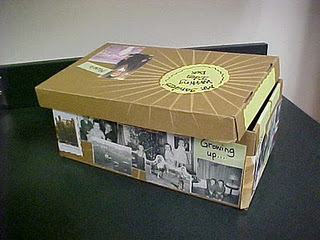
At one school, I saw students using Writing Idea Boxes. The shoe boxes had been covered with personal photos and were stuffed full of personal mementos—ribbons and awards, letters and postcards, trinkets and doodads. Each box was different, unique to the student. When I quizzed a student about her box, she told me that when she was having trouble thinking of something to write, she went and got her idea box and looked for an idea.

The next school year my students and I made Writing Idea Boxes and used them throughout the year. I have gone back to that box over and over and over when I need an idea to write about. Remember, not everything we write is for publication. Sometimes we write for the enjoyment of writing, to practice the craft of writing, or to keep up the discipline of writing. However, those seemingly non-publishable writing chunks can often lead into other works that could be sellable.


My box is covered with photos of my me as a child, my brother and sister, Granny’s farm, my parents, our cousins, photos of activities I was involved in when growing up and the activities that occupy my time and attention now, and of course there are photos of my dogs (past and present).


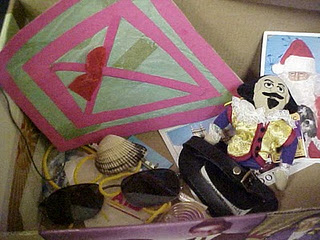
Inside the box I have a strange combination of items. Sometimes I take out some items or add something new to. The box can change, it doesn’t have to be static. Some of the items inside my box include a:
·        Kite I made as a child
·        Photo of Baxter (my dog) with Santa
·        Luggage tug from travels
·        Sunglasses and a seashell
·        Postcards of favorite places
·        Beefeater finger puppet from London

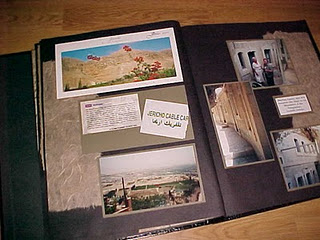
Now, don’t think I’m crazy, but let me share with you a couple of other ways of gathering memories that can lead to writing ideas. Over a decade ago I took a trip to Israel along with a film crew. We were making educational videos for the company I was working for at that time. The trip was a rich experience in many ways. I gathered up postcards and souvenirs and took many photos. I ended up with a two-volume scrapbook of photos, maps, postcards, and more.


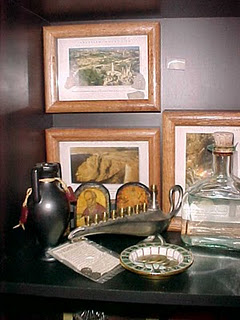
I also made a display of pottery artifacts I purchased (not shown) and physical items I collected—salt from the Dead Sea, acorns from Jericho, a candle used when touring Hezekiah’s tunnel, etc. These items are displayed so I can enjoy them and be inspired by them.


For the last couple of years I have worked off and on (more off than on) on a chapter book that is an adventure story set in Israel. These photos and physical items are the inspiration for the writing. They are the items I go back to when I need to see a scene, touch something physical to transport me back to the experience, or figure out a character’s next move.

Ideas from life surround us, yet they often are the last things we think about when it comes to a writing topic. Why not get in touch with your memories and see what ideas you can uncover.

It’s Your Turn!
1. Look through a photo album or box of mementos. See what writing ideas you can unearth.
2. Consider beginning a Writing Idea Box to serve as inspiration during those dry times when ideas just don’t seem to come.

Tuesday, November 15, 2011

Creating a Writer's Notebook

Week of October 13—Gathering Ideas
Tuesday, October 15—Creating a Writer’s Notebook

When I met Deborah Wiles and followed her from session to session at a conference a few years ago, I noticed the thick, tattered notebook she carried with her. In one session she showed the notebook and talked about how she tracked thoughts, collected ideas, recorded dialogue, and so on in her notebook. What a treasure trove.

Another writer at the same conference talked about the files she kept—clippings from newspapers, photographs, recipes, letters, and so on. These items were her version of a writer’s notebook. Still another author showed the desktop of his computer and all the idea files he had stored there.

I keep lots of electronic files. I’m a collector of ideas for titles and have files and files of titles I’ve pilfered from plays, musicals, newspaper headlines, recipes, magazine articles, holiday concert “themes,” party ideas, even the names a cake decorator gives to his designs. These titles serve as an idea file. An electronic writer’s notebook of sorts.

Lillian Morrison, poet and anthologist, writes:

“I have tons of notebooks into which I tend to throw everything—thoughts, ideas for books, early drafts of poems and letters, unfinished poems, dreams (including lines, phrases, or puns dreamed), passages from my reading that interest or move me, word lists, overheard bits of conversation, etc. Sometimes, when I need inspiration, I go back to an old notebook and a poem results. I always have a notebook next to my bed.”
From: A Writer’s Notebook: Unlocking the Writer within You by Ralph Fletcher, p. 130.


To writing teachers, Ralph Fletcher is the guru on writer’s notebooks. Fletcher’s book, A Writer’s Notebook: Unlocking the Writer within You, is used by teachers and students who are interested in learning how to create and use a writer’s notebook. Fletcher writes: “Keeping a writer’s notebook is one of the best ways I know of living a writing kind of life.” (p. 3) In Live Writing: Breathing Life into Your Words, Fletcher points out some of the advantages of using a writer’s notebook:

·        “You can let go of what others might think about your writing
·        You can let go of worries about being graded
·        You can let go of judging yourself
·        Nothing is good or bad, stupid or silly
·        Write honestly, your notebook will be filled with the true you
·        Nobody can do you better than you can”

From: Live Writing: Breathing Life into Your Words by Ralph Fletcher, p. 50.

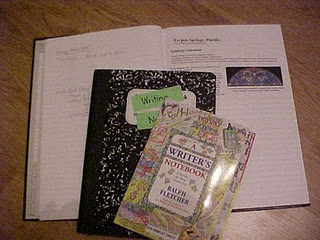
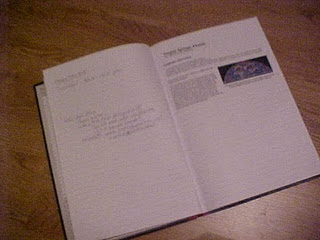
“I am still learning the discipline of keeping a writer’s notebook. My latest version of a writer's notebook is proving helpful. Not only am I recording title ideas, but lists of words, newspaper clippings and letters that could be story ideas, clip art and photographs, pre-rough drafts (you know, the notes you keep on napkins or scraps of paper), and more. I’ve given myself permission to draw, sketch, glue, staple, bend, fold, and mutilate the pages of my notebook anyway I need to in order to save the information I think is important. Neatness doesn’t count here. It’s not a scrapbook for public viewing.”


The writer’s notebook is a place to house ideas. To keep the notebook and add to it is a discipline in and of itself. But one of my goals this year is to keep AND use my writer’s notebook. I want to refer back to it, pilfer ideas from it, grab a word I've saved, and so on. I know that’s not a unique concept, but it is a realization (and a goal) for me.

It’s Your Turn!
1. Do you have a writer’s notebook? Are you actively using it? Do you need to start one? Today could be the day to start a new discipline or renew your commit to a discipline you've let slide.
2. Read Fletcher’s book A Writer’s Notebook: Unlocking the Writer Within You. Follow some of his advice. See what ideas you can generate and how your writing can be impacted.

Monday, November 14, 2011

What Authors Say About Gathering Ideas

Week of November 13—Gathering Ideas
Monday, November 14—What Authors Say About Gathering Ideas

Lois Lowry was the opening keynote speaker at SCBWI, NYC, this year. What a phenomenal choice. Lowry is an award-winning author who has written in virtually every genre. Her topic focused on gathering ideas. I cannot do justice to the presentation, but I will give a few examples of where Lowry said she gets her ideas.

FROM SORROW
A Summer to Die (Lowry’s first book) was an attempt to “give sorrow words.” Lowry’s sister died as a young adult and Lois found herself telling stories to her daughter about the sister. Those stories led to this book.

FROM REAL PEOPLE
Anastasia Krupnik was inspired by Amy Carter, daughter of then President Jimmy Carter. At the time, Carter was president and Amy Carter was a child. Anastasia resembled Amy in many ways, including physically.

FROM HISTORY
Number the Stars was based on a friend’s real-life story.

FROM WHAT-IF?
The Giver was Lowry’s example of thinking what-if questions and writing based on the answers she discovered.

FROM REWRITING OUR OWN HISTORY
Gooney Bird Green was a rewriting of Lowry’s own life. Gooney is the child Lowry always wished she could be.

FROM PHOTOS
The Silent Boy was based on a photo. Lowry’s aunt was a professional photographer who willed all her photos to Lowry. The photo that inspired this book (and that appears on the cover of the book) was one of those photos.

FROM DREAMS
Gossamer was based on “fragments and pieces of the past that became part of a dream.”

FROM EVERY DAY LIFE
Bless This Mouse (a soon-to-be-released picture book) was based on a mouse that made its way into Lowry’s home and life.

Mem Fox says this about where ideas come from:

“The best ideas, in my experience, do not come from our heads. They come from our immediate lives, or from memory, and then they are molded by our imaginations into grand stories that affect the hearts and minds of others. Stories created solely from the imagination have a flatness about them. They are usually about things that don’t matter much. They are here today and gone tomorrow. No one remembers them into adulthood.”
http://www.memfox.net/so-you-want-to-write-a-picture-book.html

Ralph Fletcher (a great author and a great teacher), gives this advice to young writers searching for ideas:

“You might try to write about:
* Family story
* A particular tradition in your family.
* An artifact (arrowhead, ring, antique, etc.). Important objects in our lives often provide excellent material to write about.
* Special place: special room, attic nook, inside of a tree, scary closet. You might start by quickly sketching a map of a house full of memories. Mark those rooms where something important happened to you.
* Brother, sister, or special relative. Remember: think small. Focus on one aspect of that person, or one experience you had with him or her.
* Your place in the family. Are you the oldest kid in your family? The youngest? Are you a middle child? An only child? Were you adopted?
* Best friend. (Did you ever get in trouble?)
* Moving. Did you leave behind a best friend when you moved from your old house?
* A disastrous time you had at camp or on a family vacation.
* Horrible haircut (or other mortifying experience)
* An injury. Did you ever have to go to the hospital?
* Important first: your first day in school, the first time you rode a two-wheeler, etc.
* Favorite pet, or a pet you once had.
* When your family changed: your brother went off to college, grandma came to live with you, etc.
* What you are (or used to be) afraid of.
* One thing you never want to do again!”

http://www.ralphfletcher.com/tips.html

I tell students they can write about anything they want to write about—the choice is totally up to them. But the easiest thing to write about is someone you know or something you have experienced. We also talk about “heart” ideas. Are there people or subjects you write about a lot? Things you are passionate about? Things you spend a lot of time thinking about or doing? Those are “heart” ideas. If you write from the heart you are more likely to touch someone else’s heart.

It’s Your Turn!
1. Go on line and visit the web sites of some of your favorite authors. Look on those sites for ways those authors find their ideas.

2. Scour the biographies, autobiographies, and memoirs of some of your favorite authors to discover their idea-gathering processes.
3. To stretch your brain about how ideas and innovations occur, watch a great YouTube video by Steve Johnson--http://www.youtube.com/watch?v=NugRZGDbPFU

Sunday, November 13, 2011

Quote of the Day

It is what it is.
But it will become what you make it.

COMING THIS WEEK!

Week of November 13—Gathering Ideas
Quotes of the week:
Always be on the lookout for the big idea that can change your life.
—Norman Vincent Peale

The difficulty lies not so much in developing new ideas as in escaping from the old ones.
—John Maynard Keynes

Again this week, in honor of PiBoIdMo, we are revisiting posts from earlier in the year to help inspire us in our journey of gathering ideas for our writing.

Monday—What Authors Say About Gathering Ideas
Tuesday—Creating a Writers’ Notebook
Wednesday—Ideas-in-a-Box
Thursday—A Picture’s Worth a Thousand Words
Friday—Snooping Through Life

For more information about PiBoIdMo, visit http://taralazar.wordpress.com/.

Friday, November 11, 2011

Using Themes to Inspire Ideas

Week of November 6—Strategies for Finding Ideas for Writing
Friday, November 11—Using Themes to Inspire Ideas

A week or so ago, some of my writing friends and I were discussing themes in fiction.  I didn’t have much to discuss actually, because I’m not all that familiar with themes (must have slept through that in high school English) and I don’t think about themes when I write.

However, as I researched themes a bit, I discovered that my stories certainly do have themes—large, universal truths—running through them. So let me share a couple of sites I discovered where you can learn more about themes for yourself.

One site I found (http://www.life123.com/parenting/education/children-reading/12-most-common-themes-in-literature.shtmlt) listed the 12 most common themes in literature. Those themes include:
·        Man Struggles Against Nature
·        Man Struggles Against Societal Pressure
·        Man Struggles to Understand Divinity
·        Crime Does Not Pay
·        Overcoming Adversity
·        Friendship is Dependent on Sacrifice
·        The Importance of Family
·        Yin and Yang: Just when you think life is finally going to be easy, something bad happens to balance it all out
·        Love is the Worthiest of Pursuits
·        Death is Part of the Life Cycle
·        Sacrifices Bring Reward
·        Human Beings All Have the Same Needs

Some are pretty heavy, huh?! But I can easily slot most picture books into those theme categories. And perhaps those themes could serve as inspiration for a story. You might say, “I really want to write about how all kids are the same and have the same needs,” and then you would find the story idea that would help you reach that theme.
Now if you really want to explore themes, check out http://homeworktips.about.com/od/writingabookreport/a/themelist.htm and you’ll discover a list of 101 common book themes. 

Thursday, November 10, 2011

Growing an Idea from a Title or Topic

Week of November 6—Strategies for Finding Ideas for Writing
Thursday, November 10—Growing an Idea from a Title or Topic

I’m sure it is apparent by now that I am a writing nerd! So it should come as no surprise that I am always on the lookout for writing ideas, topics, and inspiration. One of my more unusual writings habits involves magazines. I love flipping through magazines looking for article titles, advertisement headings, names of recipes, and more. I jot down what I find and add it to my writer’s notebook. (I admit, I do more magazine browsing than buying. So I always have a tablet or notepad nearby.)

Some of my favorite sources are:
·        Women’s magazines
·        Cookbooks and cooking magazines
·        Craft magazines and books
·        Cake decorating books and magazines
·        Children’s magazines

As you are getting up from falling on the floor with laughter, let me say I’ve written an entire story with characters names based on chicken recipes, used the name of cake to create a setting story, and found interesting verbs in a knitting how-to book.

The first step in this process is to list what you find. A chart like the one below will help. List down the titles that pop out at you. Write notes about any photographs or illustrations that catch your eye. And be tuned into what’s going on in your brain. Often when you’re thinking about something random, another good idea will popped into your head. Jot everything down.

Picture Book Ideas from Titles

Ideas from Titles
Ideas from Photos and Images
Random Ideas that Pop Into Your Head


Once I have a title or topic idea, I begin to flesh out my story. Everyone does this differently. I recently developed a Picture Book Graphic Organizer to share with my critique group. Once you’ve discovered some titles and topics try out the graphic organizer to see if it propels your idea down the road to story-dom.


 It’s Your Turn!
1. So what are you waiting for? Go search for those titles that can inspire a story!

Tuesday, November 8, 2011

What Ifs That Lead to Ideas

Week of November 6—Strategies for Finding Ideas for Writing
Wednesday, November 9—What Ifs That Lead to Ideas

What If?

Posing a question can often lead to a new idea. One kind of question to use is a “What if . . .” question. In this exercise you want to think as wildly as possible. There are no limits. I find that listing many questions is the best way for me to finally come to one that sparks my imagination.

Today I sat in a meeting (which was not sparking my imagination). Below are some “What Ifs” I brainstormed during the meeting. If any of my questions sparks a writing idea for you, go for it!

·        What if Saturn could tell how it feels?
·        What if school pictures were really X-Rays?
·        What if a baseball team had no equipment?
·        What if a parent decided to stay home?
·        What if a kid had magical powers?
·        What if you could choose a super power?
·        What if zoo animals went on strike?
·        What if book characters came to life in the library?
·        What if a circus came to school?
·        What if a kid could design his own playground?
·        What if monkeys performed ballet?
·        What if cows formed a rock band?
·        What if a pig hated mud, but loved baths?
·        What if the library was closed?
·        What if stuffed animals came to life?
·        What if there was a real boogey man?
·        What if dusty bunnies were related to non-dust bunnies?
·        What if a kid never got a haircut?
·        What if you couldn’t stop hiccupping?
·        What if a kid was a NASCAR driver?
·        What if you overslept and were late for school?
·        What if your dog was a ventriloquist?
·        What if a family vacation ended up on the moon?
·        What of the ocean were full of root beer?
·        What if the class pet was invisible?
·        What if a teacher only talked in rhyme?
·        What if s child got sucked into nursery rhymes?
·        What if kids ruled the world?
·        What if a kid’s sense of smell suddenly was 100 times greater?

What If?
It’s Your Turn!
1. Now that you’ve have the idea, grab your writer’s notebook and start making a list of as many “What If” questions a possible. When one rings your bell, stop and write!