Friday, April 8, 2011

Poetic Prose in Picture Books

Week of April 3, 2011: Picture Book Poetry
Friday, April 8:  Poetic Prose in Picture Books

One of our quotes for this week is: “Always be a poet, even in prose” (Charles Baudelaire). Today’s post was originally entitled “Free-Verse Poetry,” but when I took a second look at the books I wanted in my stack for today, I realized a better category for them would be poetic prose.

Some Definitions
Although difficult to define, poetry is brief, intense, and patterned when compared to prose. “Poetry is a type of literature in which the sound and meaning of language are compiled to create ideas and feelings.” (Arbuthnot)
Regie Routman, Writing Essentials

One of the most important concepts about poetry is that, "Like a song, poetry is meant to be heard" (Larrick, 1987, p. 20). While good prose can either be read aloud or silently, poetry nearly always needs to be read aloud. That poetry needs to be heard can be attributed to the characteristics of poetry that distinguish poetry from prose, i.e., rhythm, sound patterns, figurativeness, compactness, and emotional intensity (Lukens, 1990).
Meggie McIntosh, “Teachers—Poetry for Children—Characteristics and Examples”

I consider the books we’re looking at today to be poetic prose because they demand to be read aloud and they have “rhythm, sound patterns, figurativeness, compactness, and emotional intensity.”

Some Examples
A Halloween seasonal favorite is The Ghost-Eye Tree by Bill Martin Jr. and John Archambault, illustrated by Ted Rand. I love the descriptions in this book which tell (and show) everything you need to know without telling too much.


One dark and windy autumn night
when the sun had long gone down,
Mama asked my sister and me
to take the road
to the end of the town
to get a bucket of milk.

Oooo . . .
I dreaded to go . . .
I dreaded that tree . . .
Why does Mama always choose me
when the night is so dark
and the mind runs free?


Though I’ve mentioned Owl Moon by Jane Yolen and John Schoenherr before, there’s no way to think of poetic prose in picture books without spending some time trampling through the snow with Jane. The beautiful imagery in this book is award-winning and inspiring.

It was late one winter night,
long past my bedtime,
when Pa and I went owling.
There was no wind.
The trees stood still
as giant statues.
And the moon was so bright
the sky seemed to shine.
Somewhere behind us
a train whistle blew,
long and low,
like a sad, sad song.


 Let’s stay in the snow a bit longer with an SCBWI Golden Kite Winner, The Longest Night, by Marion Dane Bauer and Ted Lewin. I had the pleasure of hearing Marion speak at SCBWI, LA, 2010, on the topic “The 10 Basics of Picture Books.” The first characteristic she mentioned was, “Picture books are short.” The audience chuckled, but as I’ve read Marion’s books I’ve come to think she wasn’t just talking about word count, but also about compactness and the economy of words—carefully choosing only the just-right words to paint pictures in the minds of readers. Notice also the wonderful imagery in Marion’s writing.

The snow lies deep.
The night is long and long.
The stars are ice, the moon is frost,
and all the word is still.

Bears sleep, as do velvet mice.
A snow shadow lies by every tree,
thin as a hungry wolf.
“Sha-a-a,” whines the wind, the bitter wind.
“Cold and dark now rule.
Cold and dark now rule!”


 My editor (I just love to say that), Diane Muldrow, not only edits—she’s a dancer, a performer, a world traveler, and an accomplished author. Diane’s book We Planted a Tree (illustrated by Bob Staake) was just listed on the prestigious Bank Street Best Children’s Books of the Year List in the ages 5-9 category. Diane and her colleagues at Random House Children’s Books (Diane’s Golden Book imprint is one of their finest) had 85 books on the list, including 13 books with outstanding merit! The poetic verse in We Planted a Tree is something we all can celebrate.

We planted a tree.

We planted a tree and it grew.

We planted a tree and it grew up,
While it reached for the sky and the sun.

The sunshine went into the leaves
And brought food to the tree,
And the tree grew up.

Some Fun
As we wrap up our week of poetry in picture books, let me recommend a fun read that’s not poetic in style, but in subject matter.


Stanza by Jill Esbaum and Jack E. Davis is the tale of a slobbery, tough-as-nails dog who longs to write poetry (but no one can find out or his reputation would be ruined). Then Stanza enters a poetry contest and . . . sorry . . . you’ll have to read the book to learn what happens to this poetic dog!

It’s Your Turn!
1. Inspired yet? I’ve been revisiting many of my manuscripts this week to see how I can revise them based on my poetic findings. I challenge you to do the same.
2. Above all—check out some of the books mentioned this week and read, read, read!

Thursday, April 7, 2011

Rhyming Poems in Picture Books

Week of April 3, 2011: Picture Book Poetry
Thursday, April 7:  Rhyming Poems in Picture Books

Rhyme is something I’m still learning about. Poetry is something I’m still learning about. Picture books are something I’m still learning about. So today’s post is all about things I’m learning and have discovered. Don’t think of me as an expert—I’m not! Just a curious learner.

There are many rhyming picture books out there. Some are fine, many are awful, a few are amazing. A few of the amazing rhyming picture books are actually examples of poetry. Now I’m not talking about collections or anthologies of poems, but I mean an entire story told in rhyming poetry. I’ll show you a few favorites. Each has volumes to teach us.


Earlier this week, I mentioned Once Upon a Twice by Denise Doyen and Barry Moser. This book, based on Lewis Carroll’s “Jabberwocky” poem, is a master class in how to create a classic, poetic picture book. Consider this one passage and analyze the rhyme you find:

But no!
Jam scritchscrambles in a log!
Heart a-poundin’, in a-fog,
Disturbs a tadpole-tailed frog,
Then hogs her hiding place till dawn.

Skulking back—he hugs the walls,
Familiar, worn, grasshadowed halls
That lead to Sweet Home after all!
Rejoicing calls: “Our Jam’s not gone!”

Mouse years go by . . .

From: Once Upon a Twice by Denise Doyen and Barry Moser, pp. 22-23

The rhymes within each stanza and then the rhymes at the end of both stanzas provide the rhyme scheme. But what makes this poetry to me is far beyond the rhyme . . . it’s the meter, of course, but also the inventive word choice and even the word inventions. The imagery is painted succinctly with carefully selected words. What a masterpiece!


If you want to see a perfect example of a rhyming poetic picture book that seems both commercial and literary, then look no further than All the World by Liz Garton Canton and Marla Frazee. As you read this book you will see the difference between poetry in a picture book and a story line in a picture book. Notice how each stanza of the poem tells about a different thing in the world and that the ending phrase of all the stanzas begins with “All the world . . .”

Rock, stone, pebble, sand
Body, shoulder, arm, hand
A moat to dig, a shell to keep
All the world is wide and deep (pp. 3-6)

Skip, trip, stumble, fall
Tip the bucket, spill it all
Better luck another day
All the world goes round this way (pp. 20-23)

From: All the World by Liz Garton Canton and Marla Frazee


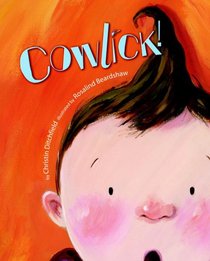
How about a hilarious, fun example? Cowlick! by Christin Ditchfield and Rosalind Beardshaw is guaranteed to crack you up! This is also a perfect example of how the illustrator tells the other half of the story. Even though the text doesn’t reveal who the secret cowlicker is, the illustrations give us clues. There’s also a sub-plot going on in the illustrations featuring the dog. The dog is never mentioned in the story text, however. In this book the rhyming text (which still seems of a poetic nature to me) actually tells a complete story.

When the moon rises high
and the stars shine bright
Little boys in bed with their eyes shut tight

Clip-clop, clip-clop down the hall
Funny shadow on the wall
Closer now—tiptoe, tiptoe
Doorknob turning very slow.

From: Cowlick! by Christin Ditchfield and Rosalind Beardshaw, pp. 5-10


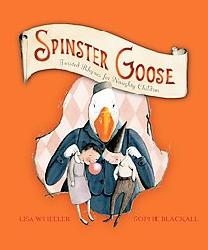
Anyone who reads my blog knows that one my favorite writers (and a person I consider a mentor) is Lisa Wheeler. Lisa is a rhymer extraordinaire and a fantastic story teller. Her latest book, Spinster Goose: Twisted Rhymes for Naughty Children (illustrated by Sophie Blackall), tells the story of Mother Goose’s sister, Spinster Goose, who owns a school to deal with children who are the worst of the worst. I bet you’ll recognize many of these kids and you’ll recognize the nursery rhymes used as the inspiration for each entry.

This week Spinster Goose is featured in Entertainment Weekly’s “The Chart” Top 10 Hard-Cover Best Seller List! WOW!

This book is a sort of a new genre to me. Poetry, yes . . . picture book, yes . . . no story line, but a story all the same. Whatever you call the genre, the book has cool, inventive word play and stellar rhyming throughout. Here’s one, short excerpt:

The Menu
Peas porridge hot.
          (I hate this food a lot.)
Peas porridge cold.
          (All moldy, green, and old.)
Peas porridge thin.
          (In slimy gelatin.)
Peas porridge thick.
          (I think I’m feeling sick.)

From: Spinster Goose: Twisted Rhymes for Naughty Children by Lisa Wheeler and Sophie Blackall, p. 21.
It’s Your Turn!
and read Bruce Lanksy’s poem “What I Found in My Desk.” Let this poem inspire you to write a rhyming poem of your own. Maybe you could write about what you found in your purse, car, your child’s backpack, etc. Anyone brave enough to share may post your poem in the “Comments” section.
2. If you are using rhyme in one of your manuscripts, think of the great examples of rhyming, poetic text we’ve seen today. Let these books (and others like them) guide your work.

Wednesday, April 6, 2011

Repeating-Pattern Poems

Week of April 3, 2011: Picture Book Poetry
Wednesday, April 6:  Repeating-Pattern Poems

Another frequently used structure or method of poetry writing is the use of a repeating line or phrase. Sometimes the repeating line is a stem that leads into the stanza. Other times the repeat is a refrain following a stanza. This form is used frequently in picture books (even ones that might not be considered poetry).


The Important Book by Margaret Wise Brown (best known as the author of Goodnight Moon and The Runaway Bunny) and Leonard Weisgard is an example of a picture book with a repeated pattern. Warning this is an old book—original copyright 1949. But the book is still out there on someone’s back list and is used frequently in school settings. Wise Brown uses repetition in two ways. Each page of the book begins with the repeating phrase: "The important thing about an _____ is . . .” and then the entire first line is repeated at the end of the page. For instance:

The important thing about rain is
that it is wet.
It falls out of the sky,
and it sounds like rain,
and makes things shiny,
and it does not taste like anything,
and is the color of air.
But the important thing about rain
is that it is wet.

From: The Important Book by Margaret Wise Brown and Leonard Weisgard, p. 8


Another picture book classic, Love You Forever by Robert Munsch and Shelia McGraw, also uses a repeated refrain throughout the book:

Practicing Repeated Patterns
Below are two poetry writing exercises that encourage the use of repeating patterns. Try your hand at them and you may find inspiration for your future writing. My friend, Sharon Waite, and I developed the activities when we were teaching together.

Color Poem
This poem allows you to practice sensory details and similes. Think about your favorite color. Express your feelings about a single color with analogies or similes or list nouns which are (or remind you of) that color. Another easy form is to use the 5 senses by saying what the color . . .
. . . looks like
. . . sounds like
. . . smells like
. . . tastes like
. . . feels like

Orange
Orange is the sun sliding to the horizon after a summer day.
Orange is the sound of a dribbling basetball.
Orange is the smell of a tiger lily petal.
Orange is the taste of a thirst-quenching Nehi Soda.
Orange is the color of peach marmalade on a side of toast.
Orange is the sound of a carrot popping out of the ground.

Why stick with one color? Explore your largest set of crayons and see how far you can take this repeated pattern.

Repeating Simile/Metpahor
We’ve talked about similes and metaphors before. It is easy to use a simile or a metaphor to structure a repeating line in a poem. You can then use that repeating subject to list similes or metaphors that describe the subject. The exercise could help you find that one perfect simile or metaphor that would make a piece of writing zing! Let me share an example.

The Sun

The sun is an orange sitting on a tablecloth of blue.
The sun is a basketball arcing toward the net.
The sun is a dingy bobbing in an azure ocean.
The sun is a golden button on an indigo shirt.
The sun is a cantaloupe in a blue glass bowl.

It’s Your Turn!
1. Go on a book hunt to find picture books that contain poetry using repeating patterns.
2. Try out some of the exercises above. Take a risk and share what you create!


Tuesday, April 5, 2011

Structured Poems

Week of April 3, 2011: Picture Book Poetry
Tuesday, April 5:  Structured Poems

When was the last time you wrote a Haiku or Cinquain? Chances are, it’s been awhile. I want to use these small, structured poems (and others like them) to force myself to choose the best words possible, to communicate ideas succinctly, and to use specific and sensory details. I don’t know if I will ever actually include any of these poems in a picture book, however. Even if I don’t, I think the discipline of writing structured poems on a regular basis could impact the overall quality of my writing.

HAIKU
Haiku is an ancient Japanese poem structure which usually includes 17 syllables. Haikus are most often written about nature. In her undated book, Aware: A Haiku Primer, Betty Drevniok says: “Write [Haiku} in three short lines using the principle of comparison, contrast, or association." Haikus usually follow this pattern:

Line 1 – 5 syllables
Line 2 – 7 syllables
Line 3 – 5 syllables

Example:       Blackberry Winter
Final frost before seedtime
Pre-spring ritual

This sample is Haiku at its simplest and I’m not trying to consider/remember all the various rules you read about writing Haiku. I’m not stressing over punctuation or capitalization either. What I am doing is reaching for the best words. Believe it or not the seventeen syllables above were revised eight times. I began with this:
Spring is here again/Flowers bloom pretty colors/Lovely smells everywhere. Then I started searching for clear focus, better imagery, and for words to clearly represent my ideas. I also tried to include an element of comparison, contrast, or association.


If Not for the Cat by Jack Prelutsky is a picture book featuring seventeen haikus about animals. Here’s an example:

If not for the cat,
And the scarcity of cheese,
I could be content.

Ted Rand’s illustrations pull the Haikus together into a seamless book. You can view the entire text at

TANKA POETRY
Before there were Haikus, there were Tanka poems. Tanka is the original Japanese poetry form and consists of five lines. Tanka is more than 1000 years old. Any educated or cultured person in Japan would write Tanka poems as a way of showing appreciation for the things around him or her. Here’s the basic guide for writing a Tanka.

·   Line one: Five syllables
·   Line two: Seven syllables
·   Line three: Five syllables
·   Line four: Seven syllables
·   Live five: Seven syllables

Because Tanka has more lines than Haiku, the form allows the poet more opportunity to paint a word picture. The subject matter for Tanka poems is less restrictive than Haiku, but traditionally the subject matter was love. Later, nature themes became more prevalent in Tankas.
Traditional Tanka poets often chose paper and ink that matched the mood of their poem and sent each poem along with a flower to the person for whom it was written. (Adapted from Writer’s Digest, April 2007, page 92.)
Below are three of my Tanka attempts:
Lapping ‘round my legs
Then pushing back out to sea
Droplets of water
Cling and glisten on my skin
Ocean waters call to me

One crimson red rose
Holds its head up to the sun
Swaying in the breeze
Sending its fragrance skyward
In a springtime dance of praise

Your obnoxious breath
Your tangled hair—what a mess
You slurp when you drink
You have gas after you eat
But you’re my dog—I love you

I see some possible uses for Tanka in my writing. The length allows me to say more and the structure doesn’t stand out in quite the same way as in a Haiku. Maybe I could tuck a Tanka in here and there in a piece of writing or even use the format throughout an entire manuscript.

CINQUAIN
The word Cinquain is derived from the French word cinq meaning five. The form of poetry was actually created by American, Adelaide Crapsey. I’ve always thought of Cinquains as five lines with eleven words. However, some poets are more specific and say there are a prescribed number of syllables per line. I’ve never written Cinquains counting syllables, but you might want to research the topic and try it yourself. The five-line format I always use is:

Line 1: One word (Subject or noun)
Line 2:
Two words (Adjectives to describe line 1)
Line 3:
Three words (Verbs to describe action relating to line 1)
Line 4: F
our words (Feelings or a complete sentence relating to line 1)
Line 5:
One word (synonym for line 1 or one word that sums up the entire poem)

Since a thunderstorm is raging at the moment, I’ll use that as the subject for my example.

Thunderstorms
Cloudy avalanche
Pouring, Banging, Crashing
Lightening strikes strike fear
Torrents

To find additional Cinquain patterns, visit: http://hrsbstaff.ednet.ns.ca/davidc/6c_files/Poem%20pics/cinquaindescrip.htm

At http://ettcweb.lr.k12.nj.us/forms/cinquain.htmyou can instantly create a Cinquain and print it out. 

DIAMANTE
The Diamante is a form similar to the Cinquain. The text forms the shape of a diamond. I love the way this poem structure compares two things. I believe I can find ways to use this in my writing. Even if I don’t use the actual format, a Diamante might give ideas for ways to simplify or poetically state a comparison.

Line 1: Noun or subject—one word
Line 2: Two adjectives that describe line 1
Line 3: Three verbs that describe line 1
Line 4: Four nouns—the first two are connected with line 1; the last two are connected with line 7
Line 5: Three verb words that describe line 7
Line 6: Two adjectives that describe line 7
Line 7: Noun Synonym for the subject


An example:
Pencil
Sharp, skinny
Writing, answering, erasing
Wood, lead, ink, plastic
Drawing, smudging, leaking
Durable, comfortable
Pen

Let structured poems help you with word choice, imagery, comparisons, and more. Carefully choose your words to communicate your message. Then let your poetic experience impact your writing.

It’s Your Turn!
1. Try your hand at a structured poem or two.
2. Add one or two of your poems to the “Comments” section of this post for others to enjoy!

Monday, April 4, 2011

Poetry in Picture Books

Week of April 3, 2011: Picture Book Poetry
Monday, April 4:  Poetry in Picture Books

I had to admit to someone the other day that this blog is actually my way to dive deeper into picture books and to find out what makes me love them. In the process, my plan is to become a better picture book writer. (A side benefit of this process, is that I get to make picture book writing friends along the way.) So I'm being selfish with my topic this week, it's something that interests me (and hopefully will interest you, too).

I’m trying to learn more about—poetry in picture books. I think in the picture book world of exploding chickens, dancing princesses, and talking puppy dogs that we sometimes forget to see and acknowledge books that are filled with great words. Maybe that’s because they’re less marketable or not currently trendy, but I think books with well-honed words . . . words carefully chosen and placed . . . may be the books that truly become timeless. Many people call these works literary. Let's just call them good!

Let me begin by showing you some wonderful examples of picture books with poetry. These are books to go out and put your hands on ASAP. They are a writer’s and illustrator’s dream come true.


A CLASSIC
When I saw a picture book with a cover proclaiming Walt Whitman as the author, I did a double take. But there it was—When I Heard the Learn’d Astromomer—based on the poem by Walt Whitman and gloriously (and I don’t use that word lightly) illustrated by Loren Long. Long took the beloved poem and made it a contemporary, relatable picture book tale.


A CLASSIC REVISITED
I heard Denise Doyen speak about her book, Once Upon a Twice, during a session at SCBWI, LA, in 2010. I had bought the book the day before drawn in by the title and the first two pages of the text. Doyen skillfully creates her own world in this picture book adventure. The meter is obviously based on "Jabberwocky" by Lewis Carroll. When I recognized that, I couldn’t stop reading aloud in my hotel room at the conference. I’ve seen many books based on other books (fractured fairytales and the like), but nothing like this. By the way, the illustrations by Barry Moser are fantastic.


A NEWER CLASSIC
I first became familiar with Old Turtle (story by Douglas Wood and watercolors by Chen-Khee Chee) when the men’s chorale I was a member of began to work on the extensive choral and orchestral work based on the book. This epic poem about the creation of the world and living peacefully is a parable you’ll read time and time again. I highly recommend the CD of the choral work performed by the Turtle Creek Men’s Chorale (no relationship to the book, just an interesting coincidence in name).


POETRY IN NON-FICTION
Water Dance and Cloud Dance written and illustrated by Thomas Locker show the power of poetry to communicate even in non-fiction. And if you really want to see a stellar example of poetry in non-fiction, check out Twelve Rounds to Glory: The Story of Muhammad Ali by Charles R. Smith, Jr. and Bryan Collier.

Why all this talk about poetry in picture books? Because whether its poetry or picture books or a combination of the two, writers have to carefully, meticulously, skillfully choose each word. The quote from Charles Baudelaire communicates what inspires all my posts this week: “Always be a poet, even in prose.”

It’s Your Turn!
1. I hope you have the chance this week to locate one or more of the books I mentioned today. Read them. Devour them. Inhale them. Then breathe magical words out in your writing.

Coming This Week!

Week of April 3, 2011: Picture Book Poetry
Quotes for the Week:
Poetry is what gets lost in translation.
—Robert Frost

Always be a poet, even in prose.
—Charles Baudelaire

Monday:  Poetry in Picture Books
Tuesday:  Structured Poems
Wednesday:  Repeating Pattern Poems
Thursday:  Rhyming Poems
Friday:  Free Verse Poems

Friday, April 1, 2011

Hovering Over a Cover Letter

Week of March 27: Bewitched, Bothered, and Bewildered
Friday, April 1: Hovering Over a Cover Letter

Now that I (and hopefully you) have a better idea of the publishers I want to target with my submissions, I’m ready to begin mailing out more manuscripts! I have developed a tracking sheet for my submissions. Some folks do this electronically, I like an old-fashioned clipboard. My sheet includes:
·   Publisher/agent name
·   Special submission instructions
·   Manuscript sent
·   Date sent
·   Date acknowledged
·   Additional notes

I’ve used this sheet for some time and it’s succinct and effective.

Queries and Covers
You hear the terms query letter and cover letter a lot in this business. Simply stated a query is a question—Hey, I’ve got something here, do you want to see it? A cover letter literally covers (sits on top of) the manuscript you are mailing in. Cover letters are what we use mostly as picture book writers. Most publisher’s and agent’s submission instructions tell picture book writers to send the entire manuscript with a cover letter. On occasion you will find a publisher or agent who wishes to be queried first about a picture book. (I only found one publisher like this in my search of 2011 Children’s Writer’s & Illustrator’s Market®.

Those companies and agents that request an email submission also expect that the email will begin with the “cover letter” (which technically is not a letter, but is in letter format).

Basics of Cover Letters
1.  No more than one page
2.  Business letter format, single spaced, an acceptable font (just like your manuscript). I use Times New Roman, 12 pt. (Don’t try to be clever and use fancy fonts or 10 pt. type to try to squeeze more info into one page.)
3.  Address the letter to a specific person—check and double check the spelling of the name and the person’s title. (NOTE: Sometimes a company will require you send an unsolicited manuscript to Manuscript Submissions or a similar title. Always do what the company requires.)
4.  Start with a hook. Grab the reader’s attention. I like to make a personal connection (if I have one) with the editor/agent, acknowledge something about the company’s wants/needs, and then throw in my hook. For instance:

Ms. Smith, I enjoyed your presentation at SCBWI, NYC, and was encouraged by your positive outlook on the current state of publishing. I know at Smith Publishing you like books with humor, strong characters, and surprise endings. I think my wacky tale about Festus, a flamingo who hates seafood, warm weather, and being pink, would be a nice fit for your list.

5.  Next, include your one-paragraph pitch/synopsis. (See yesterday’s post.)
6.  In the last paragraph of your letter tell a bit about yourself—but stay professional. Being a school teacher, working in a library, reading to children every Saturday at the community center may give you credibility. On the other hand, saying that your children or grandchildren love your book probably won’t give you credibility. Saying that you are published in other genres in the children’s market could give you credibility, but saying you wrote for your high school newspaper probably won’t. End by thanking the editor/agent and say that you are looking forward to hearing back from him/her.

A Sample of a Successful Cover Letter
Below is the cover letter for my book, Cowboy Christmas. This was not an unsolicited submission, but for the most part the cover letter would work if the manuscript had been unsolicited.

August 23, 2010

Xxxxx Xxxxxxx, Editor
Golden Books/Random House
1745 Broadway
New York, NY  10019

Dear Ms. Xxxxxxx:

Thank you again for the helpful consultation you provided at the SCBWI conference in Los Angeles. Your suggestions about Cowboy Christmas helped me turn the story into a picture book manuscript. I am excited for you to see the changes.

Cowboy Christmas is a warm, humorous picture book written in 640 words. In my research I have not found a similar picture book or story line.

“Santy Claus will never find us out on the range,” Dub moaned to his fellow cowboys. Dub, Dwight, Darryl, and their cook, Cookie, were stuck roping steers, wrestling longhorns, and wrangling up strays on Christmas. The cowboys’ attempts to recreate childhood Christmas memories end with one hilarious failure after the other. But a surprise is in store for the Circle D dudes when Santa (who oddly resembles Cookie) visits their camp. The cowboy’s moaning and moping soon turn to whooping and hollering.

As we discussed during my consultation, I am an experienced writer who was published extensively. I also worked for many years as an editor, editorial manager, and project manager. I now work with kindergarteners through fifth graders as a creative writing teacher.

Cowboy Christmas is an exclusive submission. I am submitting the manuscript in two formats—a typical, double-spaced version and a version that includes illustration suggestions. For your convenience, a self-addressed, stamped envelope is enclosed. Thank you for your consideration. I look forward to hearing from you.

Sincerely,

Rob Sanders

A Great Resource
There are many resources on the market that coach you to write successful query and cover letters. There are also free helps online. The one book I own on the subject is Author to Editor: Query Letter Secrets of the Pros, edited by Linda Arms White. The book provides helpful information and examples of many query letters and cover letters for all genres of children’s writing, fiction and nonfiction. The book is available from the folks who bring you the Children’s Book Insider, the Newsletter for Children’s Book Writers and the The CBI Clubhouse (http://cbiclubhouse.com).

It’s Your Turn!
1. Have you perfected your cover letter for your latest manuscript? Now’s the time! Be sure to run the letter by your critique group for input!